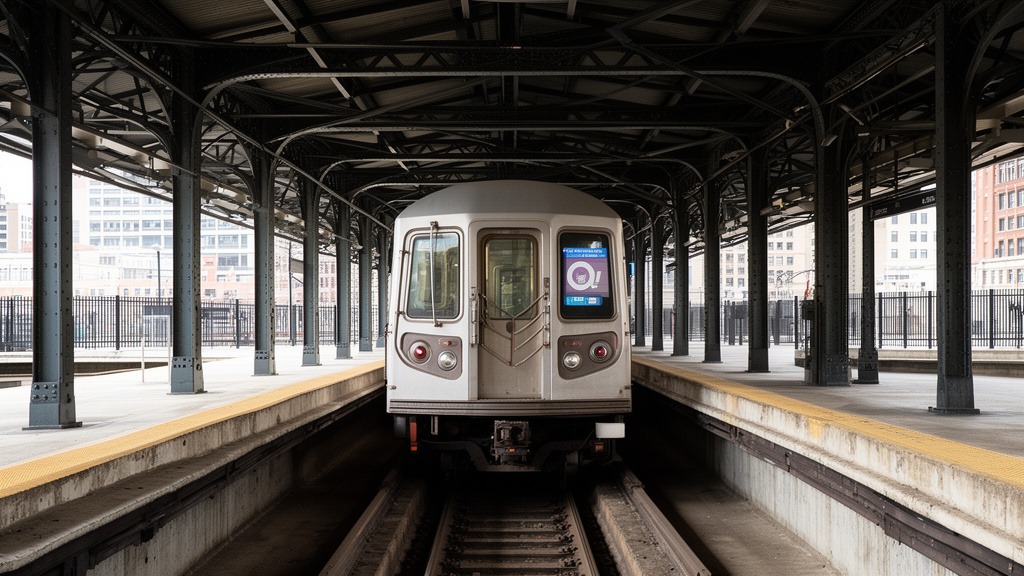
The Chicago Transit Authority (CTA) stands as the backbone of the city’s infrastructure, moving hundreds of thousands of residents daily from the Far North Side to the deep South Side. However, the system is currently grappling with a crisis of perception that threatens its long-term viability. A new, comprehensive survey conducted by the National Opinion Research Center (NORC) at the University of Chicago and WTTW News has stripped away the veneer of collective public opinion, revealing that safety on the ‘L’ and CTA buses is not a shared experience. Instead, it is a fractured reality, heavily influenced by a rider’s race, geography, and systemic socioeconomic factors. As the CTA attempts to recover ridership numbers to pre-pandemic levels, this report highlights a sobering truth: when commuters step onto a train, they are not all arriving at the same conclusion regarding their personal security.
Key Highlights
- The Racial Perception Gap: White respondents report significantly higher feelings of security while using the CTA compared to Black and Hispanic commuters, highlighting a disparity that transcends mere crime reporting.
- Geographic Fragmentation: Safety perceptions are not uniform across Chicago’s 77 community areas; riders from the South and West sides report higher levels of anxiety regarding transit safety than those from the North Side.
- Ridership vs. Reality: The survey indicates that fear of crime is a primary deterrent for ‘choice riders’—those who own vehicles but could take transit—leading to a potential permanent loss in transit revenue.
- Institutional Trust: The study suggests that perceptions are not solely based on personal victimization but are also shaped by public discourse, media coverage of CTA incidents, and trust in the Chicago Police Department (CPD) presence on trains.
The Anatomy of the Transit Perception Gap
The NORC and WTTW News study arrives at a critical juncture for the CTA. As transit agencies nationwide struggle to reconcile post-COVID ridership habits with rising public concerns about crime and disorder, Chicago offers a unique case study in urban transit sociology. The findings suggest that safety is rarely a monolithic metric. When a passenger evaluates whether they feel ‘safe’ on the Red Line at 10:00 PM, that assessment is filtered through a complex lens of historical, racial, and geographic experiences.
Race and the Construction of Safety
The most striking takeaway from the data is the persistence of the racial divide in perception. While CTA management often points to declining crime statistics or increased police presence to reassure the public, these objective metrics frequently fail to move the needle for Black and Hispanic riders. The survey implies that for these groups, safety on the CTA involves more than just the absence of a crime; it includes the quality of interactions with fellow passengers, the presence of disorderly conduct, and the perceived responsiveness of authority figures. When white commuters report feeling ‘secure,’ it may reflect a different threshold of what constitutes a ‘safe’ environment compared to their counterparts who may have long-standing concerns about systemic exclusion or over-policing.
The Geography of Fear




Beyond the racial divide, the survey maps an undeniable geographic fracture. The CTA network is designed as a hub-and-spoke system that flows into the Central Business District (The Loop). However, the transit experience for a rider boarding in the suburbs or the North Side is fundamentally different from a rider boarding in underserved neighborhoods on the South or West Sides. These neighborhoods have historically faced underinvestment and, more recently, disproportionate impacts from CTA service disruptions. The survey data corroborates that riders in these areas express higher levels of apprehension, suggesting that the ‘safety’ issue is inextricably linked to the broader issue of transit equity. If a station in a historically marginalized neighborhood is perceived as neglected, that neglect bleeds into the perception of danger.
The Economic Consequence: The ‘Choice’ Rider
The CTA relies heavily on ‘choice riders’—individuals who have the financial means to drive or use rideshare services but choose the train for convenience or environmental reasons. The survey findings are particularly alarming for this demographic. If choice riders perceive the system as unsafe, they are the most likely to defect permanently to private vehicles. This shift not only compounds Chicago’s notorious traffic congestion but also erodes the CTA’s financial stability. The report suggests that perceptions of safety act as a ‘gatekeeper’ to transit adoption; if the perception of risk is high, no amount of service frequency will induce a choice rider to return to the platform.
Secondary Angles: Future Implications for Transit Policy
1. The Policing Paradox: The survey forces a debate on the efficacy of police presence. If increased police numbers do not correlate with an increase in perceived safety among minority demographics, the CTA must evaluate if their current ‘security-first’ approach is the correct strategy or if it merely alienates a portion of the ridership.
2. The Maintenance of Dignity: The findings hint that ‘safety’ is often conflated with ‘cleanliness’ and ‘order.’ The presence of trash, broken turnstiles, and non-functional lighting at stations contributes to an environment of neglect, which lowers the threshold for feeling ‘unsafe.’ Future policy may need to focus as much on station aesthetics as on law enforcement.
3. The Role of Public Discourse: There is a recursive loop between media coverage and public perception. The report raises questions about how the amplification of high-profile, isolated incidents of violence on the CTA affects the mental calculus of the average rider, potentially creating a distorted view of systemic risk versus isolated danger.
FAQ: People Also Ask
Why does perception of safety differ by race on the CTA?
The study indicates that safety perceptions are subjective and influenced by past experiences, social context, and systemic factors. Black and Hispanic riders may encounter different stressors, witness different levels of disorder, or have varying levels of trust in the protective presence of law enforcement, leading to different assessments of the same physical environment.
Does this survey correlate with actual crime statistics?
Not necessarily. The survey measures sentiment, not police reports. The study highlights a crucial dissonance: while the CTA may implement security measures to lower crime, the ‘feeling’ of safety among the public lags behind the objective reality, influenced by media reports and environmental factors.
What are the main geographic differences?
Residents in the South and West sides, where transit dependency is highest and historical investment has been lower, report higher levels of concern compared to residents of the North Side, suggesting that transit safety is viewed through the lens of neighborhood equity.
How will the CTA likely respond to these findings?
The CTA, in conjunction with the RTA and city officials, will likely use this data to tailor community-specific communication strategies and potentially shift security resources toward station ‘hotspots’ that are perceived as the most threatening by the daily commuting public.