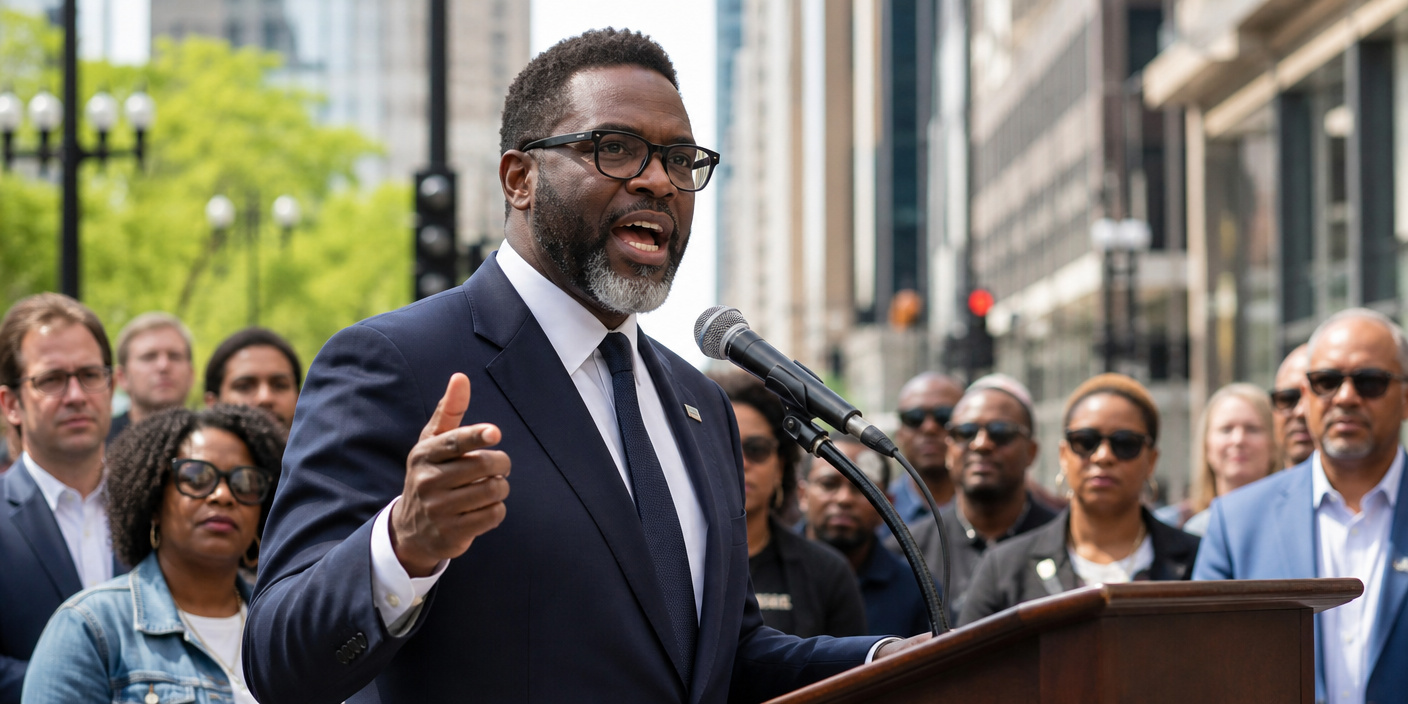
Chicago’s ambitious path toward wage equality for hospitality workers remains firmly intact following a high-stakes legislative battle that concluded this week. The Chicago City Council failed to secure the necessary votes to override Mayor Brandon Johnson’s veto of a measure that would have frozen the city’s scheduled phase-out of the tipped wage credit. With the veto upheld, the city’s “One Fair Wage” ordinance—a signature progressive policy enacted in 2023—will continue its original trajectory, with the next scheduled increase in the tipped minimum wage taking effect on July 1, 2026.
Key Highlights
- Failed Veto Override: The City Council fell short of the 34-vote threshold required to overturn Mayor Johnson’s veto, effectively ending the push to freeze the subminimum wage.
- The Path Forward: The scheduled annual reduction of the tip credit will proceed, bringing Chicago closer to a standard minimum wage for all workers by July 1, 2028.
- Next Wage Hike: On July 1, 2026, the tipped minimum wage will increase to 84% of the standard minimum wage, up from current levels.
- Industry Impact: Restaurant owners are now faced with the immediate reality of adjusting operational budgets to accommodate the next phase of the mandated wage increase.
- Legislative Standoff: The failed override signals a stabilization of the city’s labor policy, though intense lobbying from the hospitality industry is expected to continue on other fronts.
The Legislative Landscape of Chicago’s Tipped Wage Future
The failure to override Mayor Brandon Johnson’s veto marks a pivotal moment in Chicago’s labor history. For restaurant operators and labor advocates alike, the vote served as a bellwether for the future of the “One Fair Wage” ordinance, a policy that has positioned Chicago as a national leader in eliminating the subminimum wage for tipped workers. The ordinance, which was passed with the goal of ensuring hospitality workers receive a stable, consistent income, requires a five-year gradual transition.
The Mechanics of the Phase-Out
To understand the gravity of this week’s events, one must look at the mathematical structure of the ordinance. The law did not impose an immediate, overnight jump to the standard minimum wage, which would have arguably been catastrophic for many small, independent restaurants operating on razor-thin margins. Instead, the City Council designed a “glide path.”
Under the 2023 legislation, the tip credit—the portion of the minimum wage that employers are permitted to satisfy through tips received by employees—is being reduced in stages. As of the current cycle, the tip credit is being systematically chipped away. By keeping this schedule in place, the city ensures that businesses have a predictable, if challenging, timeline for labor cost increases. The failure of the City Council to override the veto means the next “step”—increasing the tipped wage to 84% of the standard minimum wage—will commence on July 1, 2026, as planned.
The Battle of Narratives: Equity vs. Economics
The legislative debate leading up to this week’s vote was not merely about dollars and cents; it was a collision of two deeply held visions for the city’s economy.



On one side, the Illinois Restaurant Association and various small business advocacy groups argued that the pace of the wage increase is outpacing the market’s ability to absorb the costs. Their argument centers on the “service inflation” model: as labor costs rise, restaurants are forced to increase menu prices, add automatic service charges, or reduce staffing levels to survive. Proponents of the freeze claimed that many local establishments, particularly in the outer neighborhoods, were nearing a breaking point where the only remaining business decision would be closure.
Conversely, Mayor Johnson and the ordinance’s progressive sponsors have maintained a narrative of worker dignity. They argue that the reliance on tips creates volatile, unpredictable income for the very workers who form the backbone of the city’s vibrant hospitality sector. By raising the floor, they aim to provide a reliable baseline, effectively arguing that a business model reliant on subminimum wages is inherently unsustainable. For the Mayor, holding the line on the veto was a defense of the core pillars of his administration’s social platform.
Operational Challenges for Chicago Establishments
With the legislative path solidified, the immediate challenge shifts to the operational floor. Restaurant owners now have clarity, but that clarity comes with a demand for fiscal agility. The upcoming July 1, 2026, increase will necessitate a review of pricing strategies and service models.
Many businesses are already exploring creative adaptations. We have seen a surge in the implementation of “service fees” replacing traditional tipping in some high-end establishments, as well as an increased reliance on technology to streamline front-of-house operations. The question for the next 12 months is not whether wages will rise, but how the industry will recalibrate to maintain quality of service without driving away price-sensitive patrons. This period will be a testing ground for the elasticity of Chicago’s dining scene—testing how much of the increased labor cost can be passed to the consumer before demand begins to sag.
The National Context and Broader Implications
Chicago’s experience is not occurring in a vacuum. It is part of a larger, national debate regarding the status of tipped workers. By successfully defending the One Fair Wage ordinance, Chicago has effectively become a case study for other major metropolitan areas considering similar labor policies. Advocates of tipped wage elimination are looking at Chicago’s data points—turnover rates, menu pricing, and customer satisfaction—to build arguments for similar legislation elsewhere. Conversely, critics are also studying the city as a warning sign of the potential pitfalls of government-mandated wage floors. The stakes of this ordinance extend far beyond the city limits, influencing labor policy discourse across the United States.
FAQ: People Also Ask
What happens on July 1, 2026, regarding wages?
On July 1, 2026, the tipped minimum wage in Chicago will increase to 84% of the city’s standard minimum wage. This is the next programmed step in the five-year phase-out of the tip credit, ensuring that tipped workers move closer to receiving the full minimum wage by 2028.
Is there any other legal avenue for restaurants to freeze the tipped wage?
While the City Council’s attempt to override the Mayor’s veto failed, there is ongoing activity in the Illinois General Assembly. Some state-level legislation has been proposed that could potentially preempt municipal labor ordinances, although the likelihood of success for such measures remains a subject of intense political debate. Currently, however, the Chicago ordinance stands.
What does the final phase-out in 2028 look like?
By July 1, 2028, the tip credit will be entirely eliminated. At this point, all covered employees in the City of Chicago, regardless of whether they work in a tipped occupation, must be paid the full standard minimum wage. Employers will no longer be permitted to use tips to offset the hourly wage requirement.
How does this affect customer tipping expectations?
Legally, the ordinance does not prohibit customers from tipping, nor does it mandate a change in tipping etiquette. However, the industry is seeing a shift where some restaurants are moving toward service-included models to offset rising labor costs. Customers should be aware that the price of their dining experience may increase, either through menu price adjustments or automatic service charges.