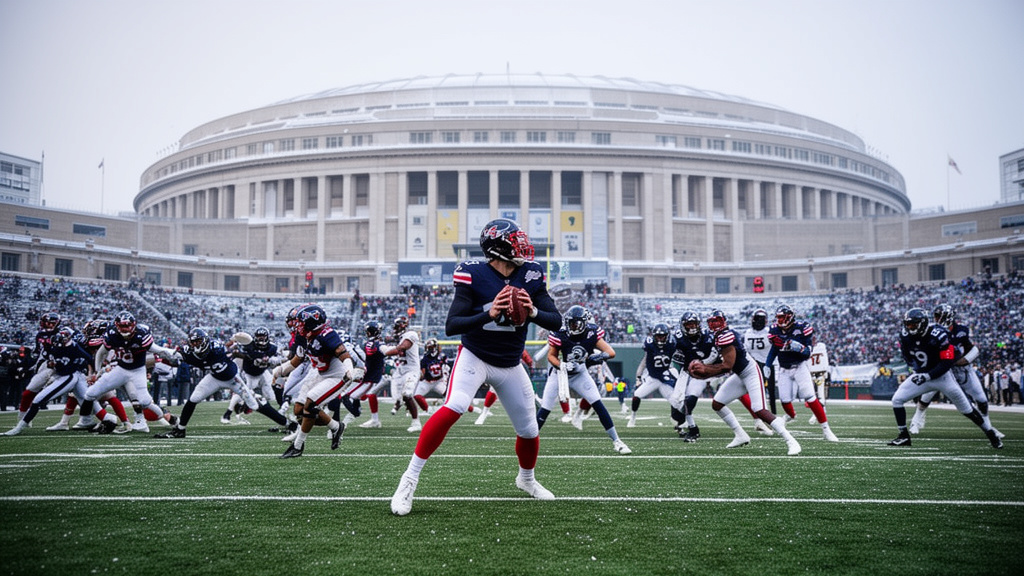
The landscape of the National Football League can change in the span of a single possession. This past Sunday served as a stark reminder of that volatility, as the Chicago Bears and the Philadelphia Eagles each orchestrated masterclass drives in the dying moments of their respective games. These victories were not merely statistical anomalies; they were demonstrations of poise, tactical execution, and the ability to operate under the crushing pressure of a zero-margin-for-error environment. For the Bears, the victory was particularly symbolic, serving as a coming-of-age moment for rookie quarterback Caleb Williams and his connection with wide receiver Rome Odunze, while the Eagles continued to solidify their stature as a hardened playoff contender.
The Chicago Bears’ Cinematic Finale: Williams to Odunze
The atmosphere at the stadium was electric as the Chicago Bears entered their final offensive sequence against the Minnesota Vikings. With time draining from the clock, the challenge was monumental. The drive was a testament to the growth of Caleb Williams, who has faced immense scrutiny throughout his rookie season. Instead of succumbing to the pressure of a collapsing pocket or the frantic noise of a defensive scheme designed to confuse, Williams displayed the tactical maturity of a veteran.
The game-winning play, a 6-yard touchdown pass to Rome Odunze with only 3 seconds remaining on the clock, was the result of precise route execution and high-level chemistry. Odunze’s ability to find the soft spot in the coverage allowed Williams to deliver a dart that secured the win. This specific play—a 6-yard connection—is significant not just for the points on the board, but for the confidence it instills in the rookie connection. It signals that the Bears’ coaching staff has the trust to put the game in the hands of their young talent during the most critical juncture of a professional football game.
Philadelphia Eagles: The Art of the Closing Drive
While the Bears were busy writing a narrative of rookie emergence, the Philadelphia Eagles were demonstrating the cold, clinical efficiency that defines a perennial contender. Their path to a final-second victory required a different set of skills: total clock management and the ability to convert crucial third downs when the defense knew exactly what was coming. The Eagles utilized a balanced attack, keeping the defense off-balance just enough to open the lanes necessary for their late-game push.




The organizational discipline shown by the Eagles—specifically in avoiding penalties and managing the huddle tempo—prevented them from stalling out in the red zone. Their ability to secure the game with a final-second score reinforces the idea that Philadelphia remains one of the most dangerous teams in the NFC, capable of winning in various game scripts, whether they are playing from ahead or, as seen this weekend, fighting for survival in the closing seconds.
Strategic Analysis: The Modern Two-Minute Drill
What links these two performances is the modernization of the two-minute drill. In today’s NFL, the ability to operate without huddling, identify defensive coverages at the line of scrimmage, and execute rapid-fire play-calling is the differentiator between a winning season and a rebuild. Both the Bears and the Eagles utilized high-percentage passing concepts, emphasizing quick releases and sideline awareness to stop the clock.
The technical evolution of these offenses shows a clear shift toward ‘situational football.’ Coaches are spending more practice time on these exact scenarios—down and distance, clock management, and personnel alignment. The success of Williams and Odunze in particular highlights the shift toward ‘big-play’ capability, where a single receiver can be the fulcrum of a game-winning strategy. For the Eagles, it is about the trench warfare and the ability to maintain a ‘clean pocket’ long enough for the play to develop, proving that even as the game gets faster, the fundamentals of blocking and timing remain paramount.
Playoff Implications and NFC Standing
The ripple effects of these two games are substantial. In the crowded NFC, every win in the second half of the season is effectively worth double. By securing these victories, both teams have not only boosted their win-loss records but have also gained intangible psychological leverage. Momentum in the NFL is a fragile thing, but a come-from-behind, last-second win is the most effective tool for galvanizing a locker room.
For Chicago, this win keeps their hopes alive and provides a foundational ‘proof of concept’ for their future. For Philadelphia, it keeps them in the driver’s seat for superior seeding, ensuring they remain the team to beat as the calendar turns toward the postseason. As we look ahead to the remaining weeks of the regular season, the resilience shown by both squads suggests that these final-second thrills may be a precursor to an intense, closely contested playoff run where every single second will again be scrutinized.
FAQ: People Also Ask
Q: How much time was left on the clock when Caleb Williams threw the winning touchdown?
A: The winning touchdown pass from Caleb Williams to Rome Odunze occurred with only 3 seconds remaining in the game.
Q: What was the distance of the game-winning touchdown pass for the Bears?
A: The game-winning pass was a 6-yard touchdown strike, successfully connecting Williams to Odunze.
Q: Why are final-second wins significant for rookie quarterbacks like Caleb Williams?
A: Final-second wins are critical for rookie quarterbacks as they provide ‘in-game’ experience in high-leverage situations, helping to build poise, confidence, and the necessary chemistry with teammates that cannot be replicated in practice.
Q: How do these wins affect the NFC standings?
A: These victories are pivotal in the NFC, as they assist both teams in maintaining or improving their positioning for potential playoff spots, making every late-season game critical for tie-breakers and overall seeding.