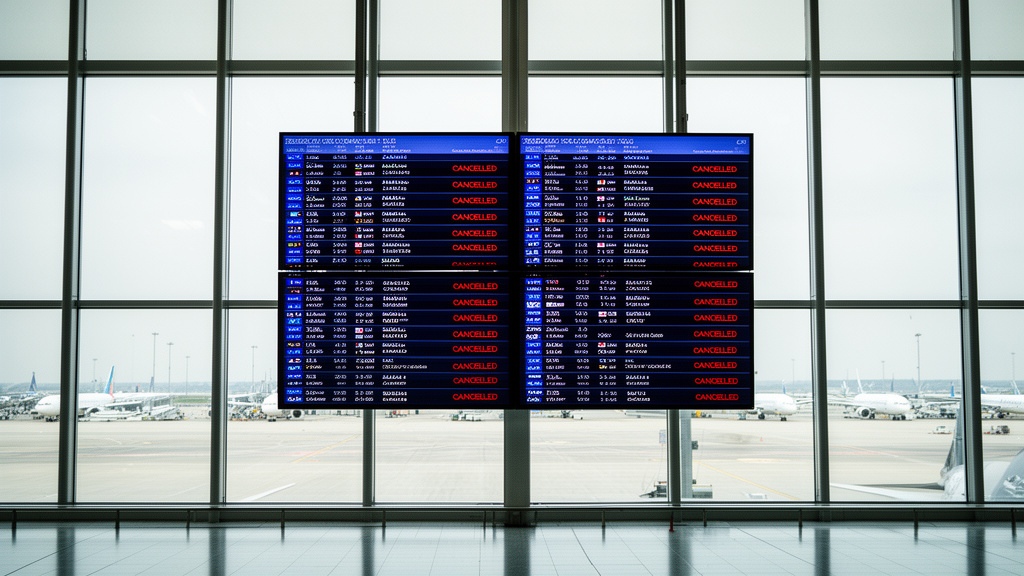
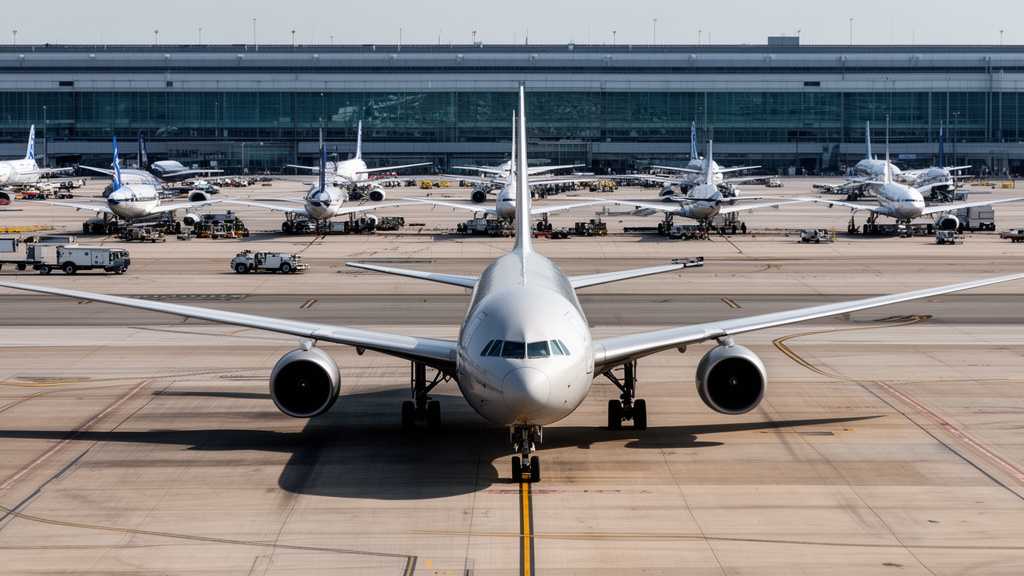
The Federal Aviation Administration (FAA) has issued a sweeping, nationwide ground stop affecting all departing flights, with major hubs like Chicago O’Hare International Airport (ORD) and Chicago Midway International Airport (MDW) experiencing immediate and total operational paralysis. The directive, prompted by a critical ‘communications equipment outage,’ has effectively halted the flow of air travel across the United States, creating a cascading logistical emergency for thousands of travelers and airline operators.
Key Highlights
- Nationwide Ground Stop: The FAA has ordered a temporary halt to all domestic flight departures due to a critical system failure.
- Chicago Impact: Major travel hubs, including O’Hare and Midway, are seeing total departures ceased, leading to congestion and flight cancellations.
- Root Cause: The disruptions are traced to a technical breakdown in the communication systems essential for safe flight operations.
- Passenger Warning: Travelers are advised to check airline status updates immediately and avoid arriving at airports until the ground stop is lifted.
The Anatomy of an Aviation System Failure
The immediate grounding of flights is an emergency measure of last resort, enacted only when the FAA deems that the systems providing real-time data to pilots and air traffic controllers are compromised. In this instance, the ‘equipment outage’ refers to a systemic failure within the backend infrastructure that distributes critical flight safety alerts. When this data stream is interrupted, the margin of error for safe flight operations shrinks to a level that the agency deems unacceptable, necessitating a complete pause in departures.
For major airports like O’Hare and Midway, the impact is magnified. As central nodes in the American aviation network, these airports manage a disproportionate volume of connecting traffic. When a ground stop is issued, the ripple effect is not linear; it is exponential. A plane stuck on the tarmac in Chicago is not just a delayed flight in Illinois; it is a missing arrival in Los Angeles, a broken connection in New York, and a stranded crew in Denver. The complexity of modern air traffic management means that when one gear in the clockwork stops, the entire mechanism ceases to function.
The Fragility of Technical Infrastructure
This incident highlights the underlying vulnerability of the National Airspace System (NAS). While aviation technology has advanced rapidly in terms of avionics and digital navigation, the foundational communication networks that facilitate these systems often rely on a patchwork of legacy hardware and outdated digital protocols. The specific failure of the communications equipment suggests a potential bottleneck in the data distribution networks that transmit safety-critical information from FAA facilities to individual aircraft.




Industry analysts have long warned that the modernization of these systems is a race against time. The transition from legacy messaging formats to modern, cloud-based data architecture is a complex, multi-year undertaking. When these legacy systems hit a breaking point, the result is the current scenario: a total grounding of the fleet. This event serves as a stark reminder that even as we enter an era of advanced automation, the bedrock of aviation safety remains dependent on the reliability of aging, sensitive telecommunications infrastructure.
Economic and Logistical Cascades
Beyond the frustration of passengers standing in terminal queues, the economic implications of a nationwide ground stop are substantial. Air travel is the nervous system of modern global commerce. From ‘just-in-time’ supply chain deliveries of perishable goods to high-stakes business travel and air freight, a halt in operations creates an immediate fiscal ripple effect. Airlines face astronomical costs associated with crew repositioning, hotel accommodations for stranded passengers, and the lost revenue of thousands of canceled flight legs.
Moreover, the environmental and operational costs are significant. Aircraft waiting on the ramp consume fuel without generating distance, and the subsequent recovery process—the ‘getting back to normal’ phase—can take days. For Chicago’s ORD and MDW, the operational strain is twofold: not only must they clear the current backlog of grounded aircraft, but they must also integrate the incoming schedule of new flights, creating a bottleneck that can persist long after the primary technical failure is resolved.
Regulatory Oversight and Future Resilience
The recurrence of system-wide failures has placed the FAA under intense scrutiny from federal regulators and the traveling public. Following similar past incidents, there have been ongoing calls for increased Congressional funding to accelerate the modernization of the FAA’s information technology infrastructure. The debate centers on whether the current oversight mechanisms are sufficient to identify and mitigate risks within the agency’s backend systems before they manifest as national service disruptions.
Moving forward, the focus will likely shift toward redundancy. The aviation industry thrives on the ‘fail-safe’ philosophy, where the presence of a backup system is as critical as the primary one. If the primary communications system failed, the fact that a nationwide ground stop was necessary suggests that either the redundancy failed simultaneously or that the system architecture lacks a sufficiently robust ‘fail-over’ mechanism. Strengthening this resilience is not merely a technical requirement; it is a mandate for public safety and national economic stability.
FAQ: People Also Ask
Q: What is a ground stop?
A: A ground stop is a temporary traffic management initiative where the FAA prohibits aircraft from departing to a specific airport or set of airports. It is used when the volume of traffic exceeds capacity or when a safety system, such as communications or navigation, fails.
Q: Why are O’Hare and Midway specifically affected?
A: While the ground stop is nationwide, these airports are high-volume ‘hubs.’ Because they manage a massive density of departing and arriving flights, the impact of a system-wide outage is felt more acutely there than at smaller regional airports.
Q: How long will this disruption last?
A: The duration depends on the speed of the FAA’s technical teams in diagnosing and resolving the ‘equipment outage.’ Once the communications system is fully restored and verified, the FAA must perform a ‘phased restart’ to safely reintegrate flights into the airspace, which can take several hours after the initial fix.
Q: Are my flights safe?
A: Yes. The ground stop is a safety-first measure. The FAA halts flights precisely to ensure that aircraft do not take off into a system where communication or safety data is unreliable. The grounding is a precautionary action, not a response to a crash or in-flight emergency.