The city of Chicago has lost its most identifiable cultural heartbeat. The passing of Mike Ditka, the legendary coach and Hall of Fame tight end who walked the sidelines of Soldier Field with the intensity of a man carrying the weight of the entire world on his shoulders, marks the end of an era. At 86, Ditka leaves behind not just a record of NFL victories, but a complex, enduring legacy that served as a mirror for the grit, the stubbornness, and the unyielding spirit of the city he called home. To understand Ditka is to understand the particular strain of optimism and agony that defines Chicago sports.
The Architect of the 1985 Dynasty
When one speaks of the Mike Ditka era, the conversation inevitably drifts toward the 1985 Chicago Bears. A team that finished with a 15-1 record, this squad remains the gold standard for defensive dominance in the modern NFL. While Ditka provided the emotional fuel and the disciplined framework, the team’s identity was forged in the fires of his relationship with defensive coordinator Buddy Ryan. This tension—between Ditka’s offensive-minded, disciplined expectations and Ryan’s chaotic, blitz-heavy 46 defense—created a pressure cooker that produced a diamond. The 1985 Bears did not just win games; they humiliated opponents with a level of ferocity that arguably changed the trajectory of defensive schemes across the league. Ditka’s ability to manage that combustible talent while steering the ship toward a Super Bowl XX victory remains his most significant tactical achievement. It was a masterclass in leadership: knowing when to demand perfection and when to allow the inherent aggression of his players to take control.
The Pugnacious Spirit of the Windy City
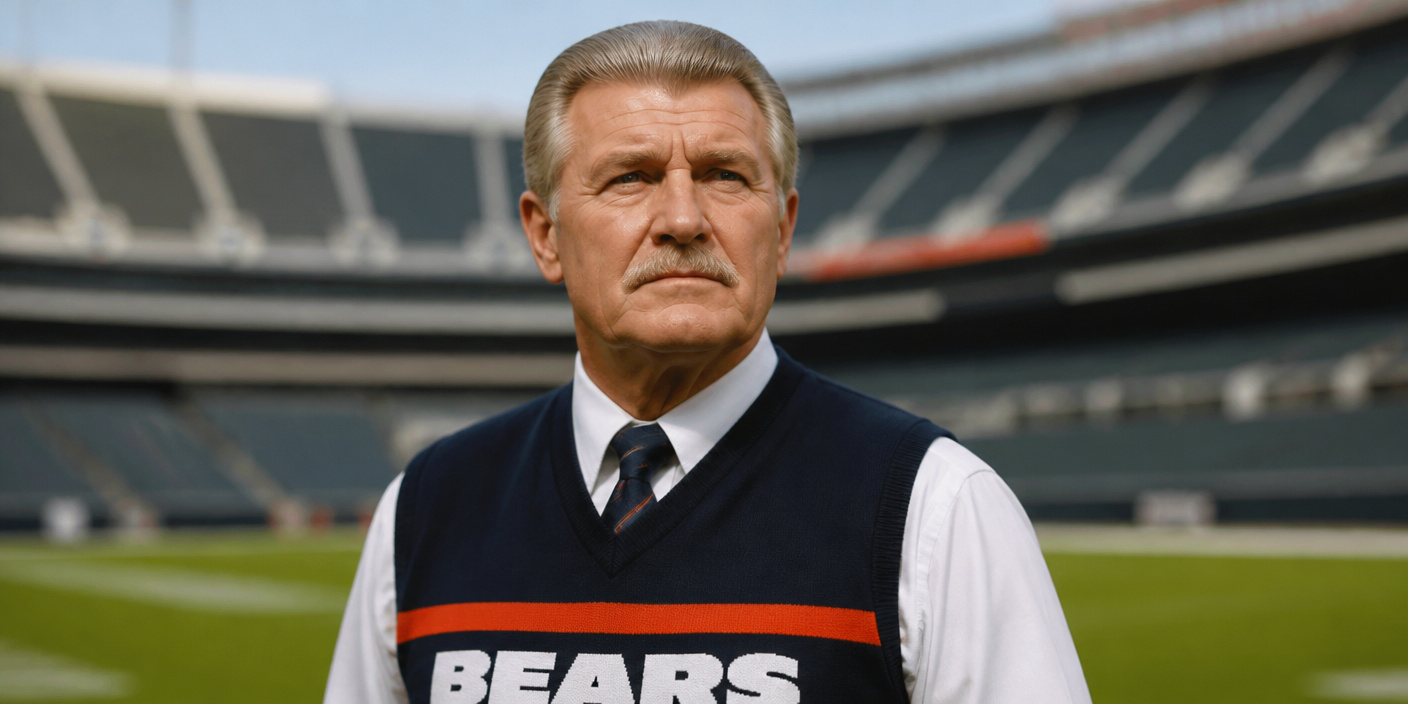
Beyond the stat sheets and the trophies, Mike Ditka served as the living embodiment of Chicago’s self-conception. In a city built on blue-collar industry, massive infrastructure, and a “do the work” philosophy, Ditka was the perfect avatar. He was never polished in the corporate sense; he was blunt, he was combative, and he was perpetually unsatisfied. This pugnacity was endearing because it felt authentic. When Ditka criticized a play call or lashed out at a referee, the fans at home felt that he was fighting their fight. He carried the “burden of destiny” with a furrowed brow, reflecting the internal struggle of a fan base that often expected greatness but lived in constant anticipation of disappointment. By demanding excellence from his players, he validated the high standards of a city that prizes toughness above all else. He was the coach who wore the sweater vest as a uniform of war, a symbol that he was in the trenches alongside his team, rather than a detached executive in a luxury box.
The Burden of Destiny: A Philosophical Coaching Model



Ditka’s philosophy was rooted in the concept of discipline as a moral imperative. He believed that the lack of discipline was not just a failure on the field, but a failure of character. This perspective occasionally put him at odds with the changing tides of the NFL, where players began to demand more agency and the game became more focused on individual branding. Ditka resisted the “me-first” era of professional sports, often to the detriment of his long-term tenure as a coach. Yet, even in his later years, his critique of the league’s evolution was consistent. He held onto a vision of football that was inherently physical, a game defined by the collision of forces rather than the finesse of schematics. This traditionalist view, while often criticized by modern analysts, created a powerful brand identity that lasted long after he stepped away from the sidelines. He became a fixture in media, a constant reminder of the “old guard” who refused to apologize for being hard on his players. The “burden of destiny” for Ditka was the self-imposed requirement to maintain that level of intensity every single day, a weight that few coaches in the history of the league have been able to carry for as long as he did.
Evolution of the Brand
Post-coaching, Mike Ditka transformed from a sideline general into a pop-culture icon. Whether through his various business ventures, television commentary, or simply his ubiquitous presence in Chicago lore, “Da Coach” remained a central figure in the conversation about the NFL. His transition from the sideline to the broadcast booth was seamless because he offered what most analysts could not: the authentic, unfiltered perspective of someone who had actually built a juggernaut. He was a polarizing figure by design; he did not seek consensus, he sought truth, as he defined it. This made him a lightning rod for debate, keeping the Chicago Bears relevant in the public imagination long after their 1985 zenith. The “Ditka” name became a shorthand for a certain type of Chicago masculinity—unapologetic, slightly nostalgic, and intensely loyal to the colors.
The Final Whistle
As we look back on his 12-season tenure as head coach of the Chicago Bears, we are forced to confront the reality that the league he helped define has vanished. The modern NFL is a vastly different entity than the one Ditka dominated. It is faster, safer, and more global, but it arguably lacks the singular, overwhelming personalities that made the 1980s and 90s the “Golden Age” for many viewers. Mike Ditka stood as the last pillar of that era. His passing is a quiet moment in a loud, rapidly moving sports landscape, allowing us to pause and appreciate the man who taught an entire city to expect more from their heroes. He was not a perfect coach, and he would be the first to tell you that, but he was exactly the coach that Chicago needed to define its identity during its most formative modern decade. His legacy is etched not just in the Pro Football Hall of Fame, but in the collective psyche of a city that remains, even in his absence, forever shaped by his pugnacity.
FAQ: People Also Ask
How many Super Bowls did Mike Ditka win?
Mike Ditka won one Super Bowl as a head coach, leading the 1985 Chicago Bears to a decisive 46-10 victory over the New England Patriots in Super Bowl XX. Additionally, he won a Super Bowl as a player with the Dallas Cowboys in 1971.
What was the “46 Defense” and why was it significant?
The 46 Defense was a revolutionary defensive scheme implemented by defensive coordinator Buddy Ryan during Ditka’s tenure. It utilized aggressive blitzing and pressured the quarterback from all angles, creating a disruptive force that redefined defensive play-calling in the NFL during the mid-1980s.
When did Mike Ditka serve as head coach of the Chicago Bears?
Mike Ditka served as the head coach of the Chicago Bears for 12 seasons, from 1982 through 1992, during which he became the face of the franchise and a cultural icon in Chicago.
How did Mike Ditka influence the culture of Chicago?
Ditka embodied the city’s blue-collar values: hard work, resilience, and a lack of tolerance for excuses. His “pugnacious” spirit and refusal to back down mirrored the identity of the city, making him more than just a coach—he was a cultural symbol of Chicago pride.